
How to Make the Right Investment in 2025
In 2025, your business website functions as far more than a simple online brochure—it serves as your most valuable digital asset and frequently forms the first impression customers develop of your brand. The challenge lies in determining whether to redesign your existing website or invest in a comprehensive rebuild. Each option offers distinct advantages, and the optimal choice depends on your technical foundation, organizational goals, and available budget.
This guide outlines the key differences between these approaches, their associated costs, implementation timelines, and a strategic decision-making framework to help you select the option that maximizes your return on investment.
Website Redesign vs. New Website Development: Understanding the Core Differences
Before evaluating your options, it is essential to understand what each approach entails
.
What Is a Website Redesign?
A website redesign service updates the visual design, user experience (UX), content structure, and on-page search engine optimization while preserving your existing core architecture and content management system (CMS). When executed properly, a redesign maintains URL structure and retains established search engine value—an important benefit for sites with strong organic performance.
A redesign is ideal for businesses with a solid technical foundation whose websites feel outdated, lack mobile responsiveness, or struggle to convert visitors into customers.
What Is New Website Development?
New website development—often referred to as a rebuild—involves creating an entirely new website or migrating to a different platform. This may include transitioning from a legacy CMS to a modern headless architecture, adopting a new framework, or restructuring your information architecture from the ground up. A rebuild enables both visual improvements and deep technical enhancements.
Rebuilds provide greater control over customization, scalability, and modern frontend technologies, making them ideal for businesses facing performance bottlenecks or significant architectural constraints.
Why 2025 Timing Matters
Core Web Vitals measure critical aspects of user experience, including page loading speed, interactivity responsiveness, and visual stability. The established benchmarks include:
- Largest Contentful Paint (LCP): Under 2.5 seconds
- Interaction to Next Paint (INP): Under 200 milliseconds
- Cumulative Layout Shift (CLS): Below 0.1
Google evaluates content on a page-by-page basis, and while no single ranking factor dominates, Core Web Vitals significantly influence search performance and user satisfaction.
Why This Matters for Your Decision
Bounce rates increase by 32% when page load time rises from one second to three seconds. Additionally, 53% of mobile users abandon websites that require more than three seconds to load.
The conversion impact is equally compelling: a one-second delay in mobile load speed can reduce conversions by up to 20%. More granularly, conversion rates decline by 4.42% for every additional second of load time between zero and five seconds.
If your site suffers from suboptimal performance, a redesign or rebuild becomes a business-critical investment—not an optional enhancement.
Website Redesign
When It Is the Right Choice
A redesign is the optimal solution if your current situation aligns with the following scenarios.
Ideal Scenarios for Redesign
Strong Technical Foundation: Your CMS, hosting infrastructure, and backend systems meet your operational needs, and your site loads within an acceptable timeframe (under four seconds).
Primarily Visual or UX Challenges: You face outdated design, poor navigation, broken conversion funnels, or content misaligned with your current brand identity.
Substantial Organic Traffic: If your site ranks competitively and receives consistent organic traffic, a redesign allows you to preserve valuable search engine optimization equity.
Limited Budget or Timeline Constraints: Redesigns are more cost-effective and faster to implement, making them suitable for organizations requiring rapid improvements.
Redesign Costs and Timeline
Redesign costs vary depending on complexity and scope, with professional small business websites typically ranging from $5,000–$10,000, reaching $20,000 or more for highly complex designs.
Most redesign projects typically fall within these parameters:
- Timeline: 8–16 weeks for mid-sized projects
- Cost: $3,000–$15,000
Redesign Return on Investment Example
Well-executed redesigns can deliver substantial improvements in conversion rates, user experience, and mobile performance—often generating measurable results within three to six months of launch. For illustrative purposes, consider that a 2% improvement in conversion rates for a site generating $10 million in annual revenue generates approximately $200,000 in incremental revenue.
New Website Development
When It Is the Better Option
A rebuild becomes necessary when your existing infrastructure limits performance or organizational growth.
Ideal Scenarios for New Development
Severe Performance Issues: Load speeds exceeding five seconds, high bounce rates, and unsuccessful optimization attempts.
Outdated or Restrictive Technology Stack: Legacy systems that cannot support modern integrations or scalable features.
Architectural Flexibility Requirements: Needs for CRM integrations, personalization engines, advanced functionality, or multi-channel content distribution.
Security and Compliance Deficiencies: Outdated codebases, absence of HTTPS encryption, or accessibility standards violations.
Organizational Scaling Requirements: Rapid business growth requiring a platform capable of handling increased traffic volume and expanded functionality.
Rebuild Costs and Timeline
Website development costs vary widely, with basic brochure sites starting around $1,000–$3,000, mid-range sites from $3,000–$7,000, and fully custom platforms frequently beginning near $10,000. For more specialized projects, business websites with custom CMS functionality range from $10,000–$30,000, while e-commerce platforms typically start at $25,000–$70,000.
Typical implementation timelines:
- Small projects: 8–12 weeks; mid-market initiatives: 12–24 weeks; enterprise implementations: 3–9+ months
Cost Comparison
Redesign vs. New Development
| Factor | Redesign | New Development |
| Design & Development | $3,000–$10,000 | $10,000–$30,000+ |
| Content Migration | Minimal | $1,000–$5,000 |
| System Integrations | Limited | $2,000–$10,000 |
| Testing & QA | 1–2 weeks | 2–4 weeks |
| Launch Risk | Low | Medium |
| Implementation Timeline | 2–4 months | 3–9 months |
| First-Year Support | $500–$2,000 | $1,000–$5,000
|
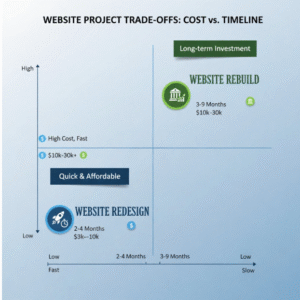
Key Insight: Redesigns offer lower costs and reduced risk when the technical foundation is stable. Rebuilds deliver maximum value when architectural improvements are required for long-term success.
Aligning Your Choice with Business Objectives
Your decision should directly align with your primary organizational objectives.
Choose Redesign If Your Primary Goals Include:
- Rapid implementation and deployment
- Enhanced conversion rates and revenue generation
- Updated branding and market positioning
- Minimal disruption to existing search engine rankings
Choose New Development If Your Primary Goals Include:
- Organizational scalability and future growth capacity
- Implementation of new feature sets and innovations
- Superior performance and competitive advantage
- Long-term infrastructure stability and maintainability
A Strategic Framework for Making Your Final Decision
Evaluate your situation by addressing the following questions in sequence:
- Is your website’s architecture limiting organizational growth or performance?
- Yes → Rebuild is recommended
- No → Redesign is sufficient
- Do you need to preserve and protect existing organic search rankings?
- Yes → Redesign is preferred
- No → Rebuild becomes less risky
- What are your budget and timeline constraints?
- Significantly limited → Redesign
- Flexible or available → Rebuild if architecture requires it
- What is your primary organizational goal?
- Conversion rate optimization → Redesign
- Performance enhancement or scalability → Rebuild
Return on Investment and Total Cost of Ownership Analysis
Evaluate your investment based on measurable business impact rather than initial expenditure alone.
Redesign Return on Investment Potential:
- Measurable improvements in conversion rates
- Enhanced user experience and engagement metrics
- Strengthened brand perception and market positioning
- Simplified content management and operational efficiency
Rebuild Return on Investment Potential:
- Complete resolution of technical debt
- Substantial improvements in page load times (up to 40% faster)
- Scalable, future-proof technical architecture
- Reduced long-term maintenance and operational costs
2025 Best Practices for Any Implementation Path
Regardless of your selected approach, prioritize the following elements:
- Core Web Vitals Optimization and Monitoring — optimize for good Core Web Vitals to improve search performance and user experience
- Mobile-First Design and Responsive Implementation — ensure your site performs seamlessly across all devices
- Security Hardening and Accessibility Compliance — implement HTTPS and follow WCAG accessibility guidelines
- Systematic Conversion Rate Optimization — test and refine user journeys to maximize business outcomes
- Strategic Search Engine Optimization Migration or Preservation — protect organic traffic through careful planning
Choose the Option That Supports Your Growth Strategy
The decision between a redesign and a comprehensive rebuild is fundamentally strategic—not purely financial.
Select a redesign if your technical foundation is solid and your primary objective is achieving rapid, low-risk improvements in user experience, conversion rates, and brand presentation.
Select a rebuild if your current website’s limitations impede performance, scalability, or feature development. Although the upfront investment is greater, the long-term organizational gains can be substantially more significant.
In 2025, performance optimization, responsive design, and Core Web Vitals compliance are non-negotiable requirements for maintaining competitive advantage. Ensure your selected approach strengthens your digital presence and positions your organization for sustainable growth.
Need Expert Guidance for Your Specific Situation?
At Web Craft Code, we help organizations evaluate both approaches and select the strategy that maximizes long-term return on investment. Whether you require performance optimization, a modern rebuild, or a strategic redesign initiative, our team is prepared to assist